This page gives a sample of the problems I work on;
however, it cannot give a complete overview of my research. If you
would
like to get this overview, or if you would like to know the details of
the work described below, please consult my list
of publications or contact me by email.
| Coda Wave Interferometry | Inverse Problems |
| Passive Imaging | Wave Propagation |
| Liqufaction, Landslides and Volcanoes | Surface Wave Tomography |
Presently it is not known to what extent multiple scattered
waves can be used for imaging techniques. However, in many applications
one is not so much interested in creating an image, as in knowing:
whether or not the medium has changed. Examples include dam-monitoring,
volcano monitoring, and non-destructive testing. Multiple scattered
waves are a very sensitive diagnostic for detecting changes in media.
CSM doctoral student Alex Gret, who completed his thesis in July 2004,
carried out a laboratory experiment to measure velocity changes in
granite due to changes in temperature. With this technique, a relative
velocity change of 0.1% can be detected with an error as small as
0.02%. We published this work in Science.
We recently carried out a field experiment in the
experimental mine of the Colorado School of Mines in Idaho Springs. In
the adjacent picture, I am drilling a hole for mounting a geophone.
With
a hammer we excited seismic waves in a mine pillar. With a hydraulic
jack we could change the stress in the pillar. The waveforms before and
after the stress change are shown in the figure below in red and blue,
respectively. The inset in the top-right shows the first-arriving
waves; these are unaffected by the stress change. The inset in the
lower right shows the later arriving waves. These waves have
systematically changed because of the stress change. This illustrates
the principle of coda wave interferometry. Waves that are scattered
have more often sampled a limited region in space than the directly
arriving waves. This increased sensitivity can be used to monitor
minute changes.

Click here for another example of coda wave interferometry.
The
image on the left shows the water surface in a pond while it is
raining.
Suppose we measure the motion of the water surface at the two
receivers, could we then construct the wave that travels between the
two receivers? If we could excite waves at one of the two receivers
this would be simple. If we cannot excite the waves, we can use the new
technique of passive imaging to construct the wave that travels between
two receivers without using a source. This technique is based on
correlating the waves recorded at the two receivers. This technique is
of great practical importance because it allows us to do imaging
without using an active source.
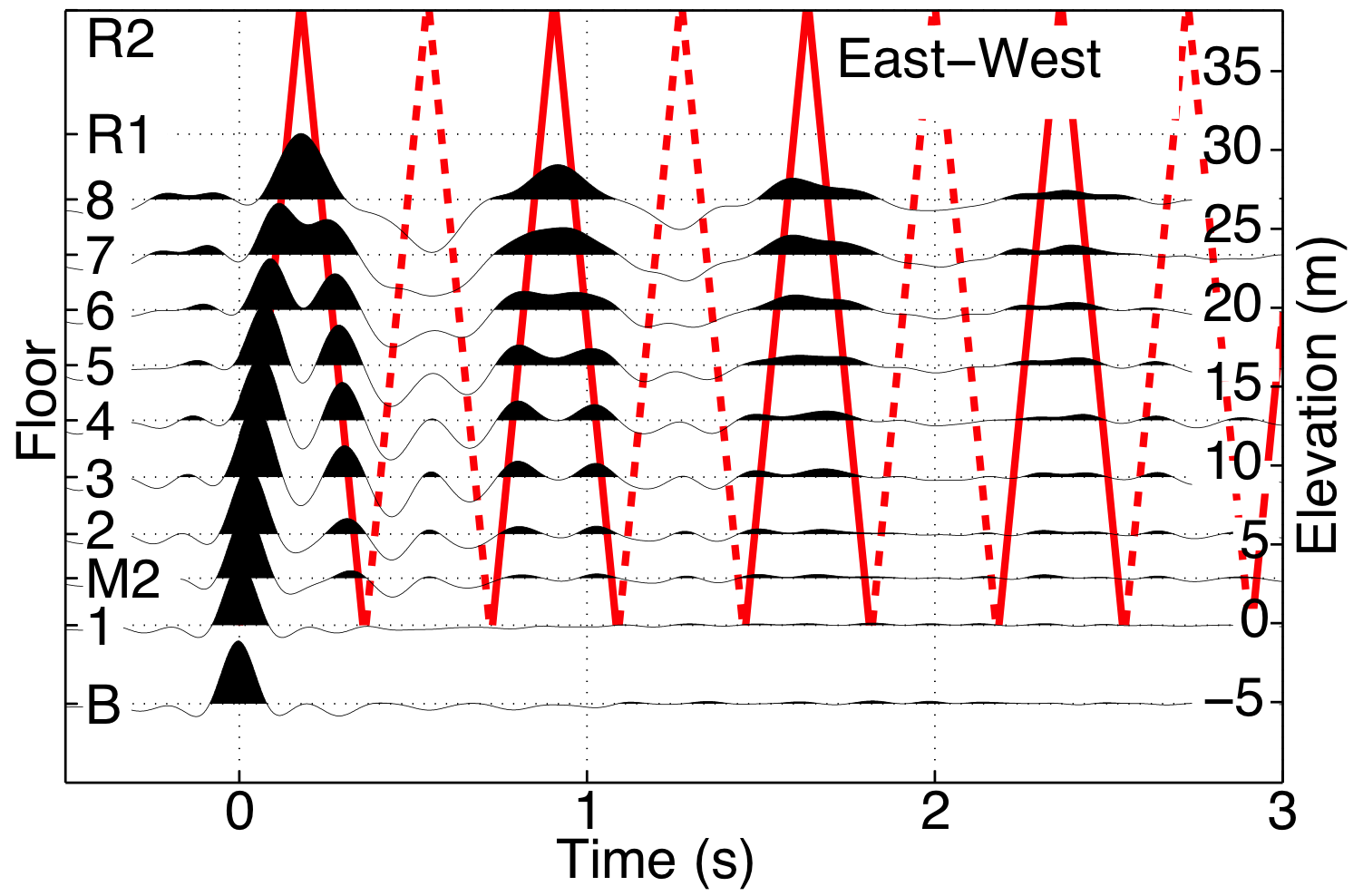
In a theoretical study I showed a new derivation of this principle that
is based on the stationary-phase evaluation of scattering integrals.
The work was recently published in Physical
Review E. The derivation is based on random media, but in this
paper I show that for a single realization of a medium the method of
passive imaging is also applicable because the time-averaging in the
correlation plays the same role as does ensemble averaging.
Computer simulation of the shear modulus before
and
after liquefaction generated by an incoming S-wave.
In collaboration with the granular media group at the
Colorado School of Mines I am setting up a program on liquefaction
problems. In this program we describe liquefaction both on a
macroscopic scale as well as on a microscopic scale. Our first
paper on this
topic appeared in the physics journal Granular
Matter. We are interested in exploring the implications of our work
for natural hazard problems.
Together with the National Earthquake Information Center of the USGS we are working on the initiation of landslides by extensional failure.
In collaboration with Mike Hagerty from New Zealand,
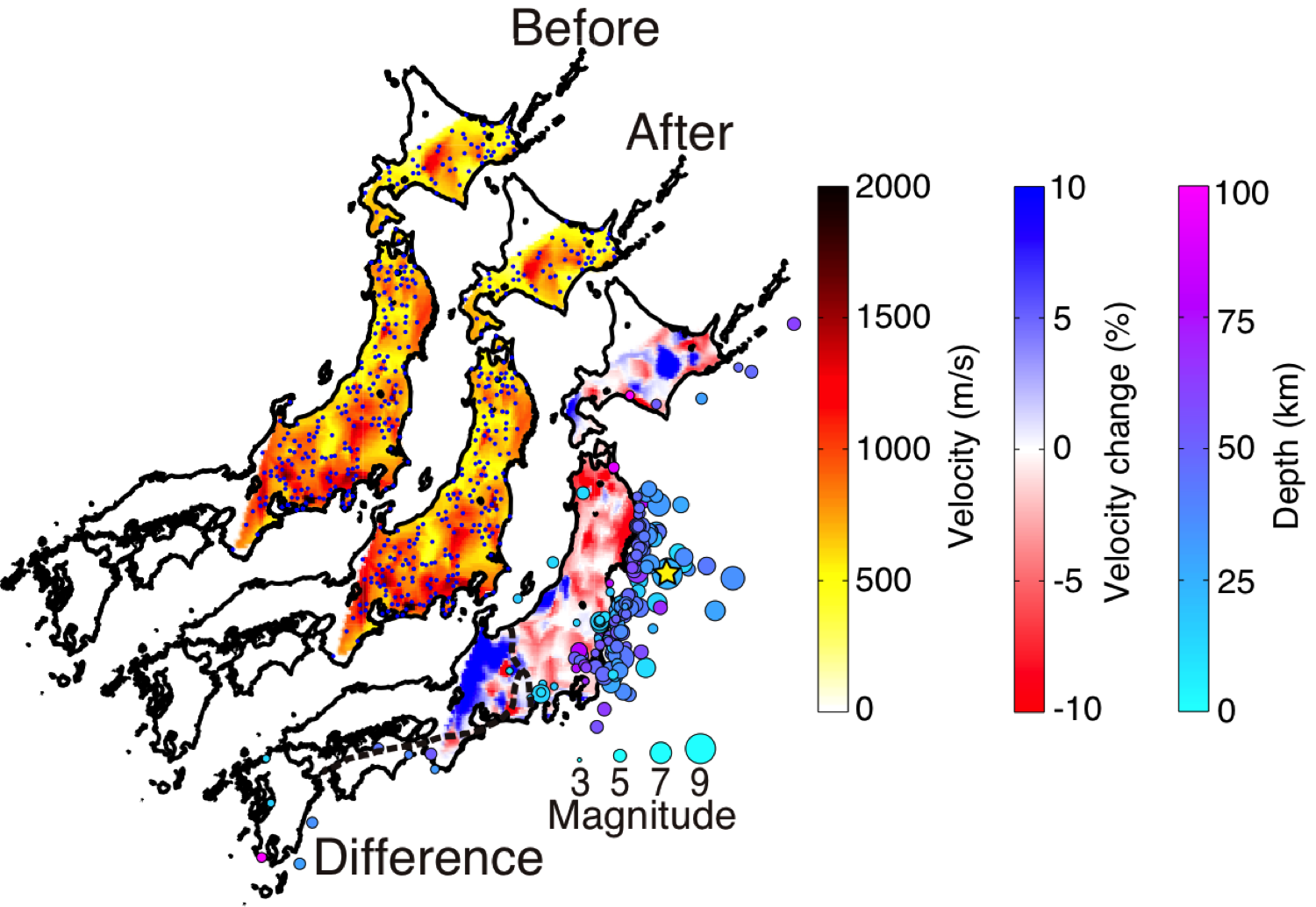
I have applied coda wave interferometry (see above)
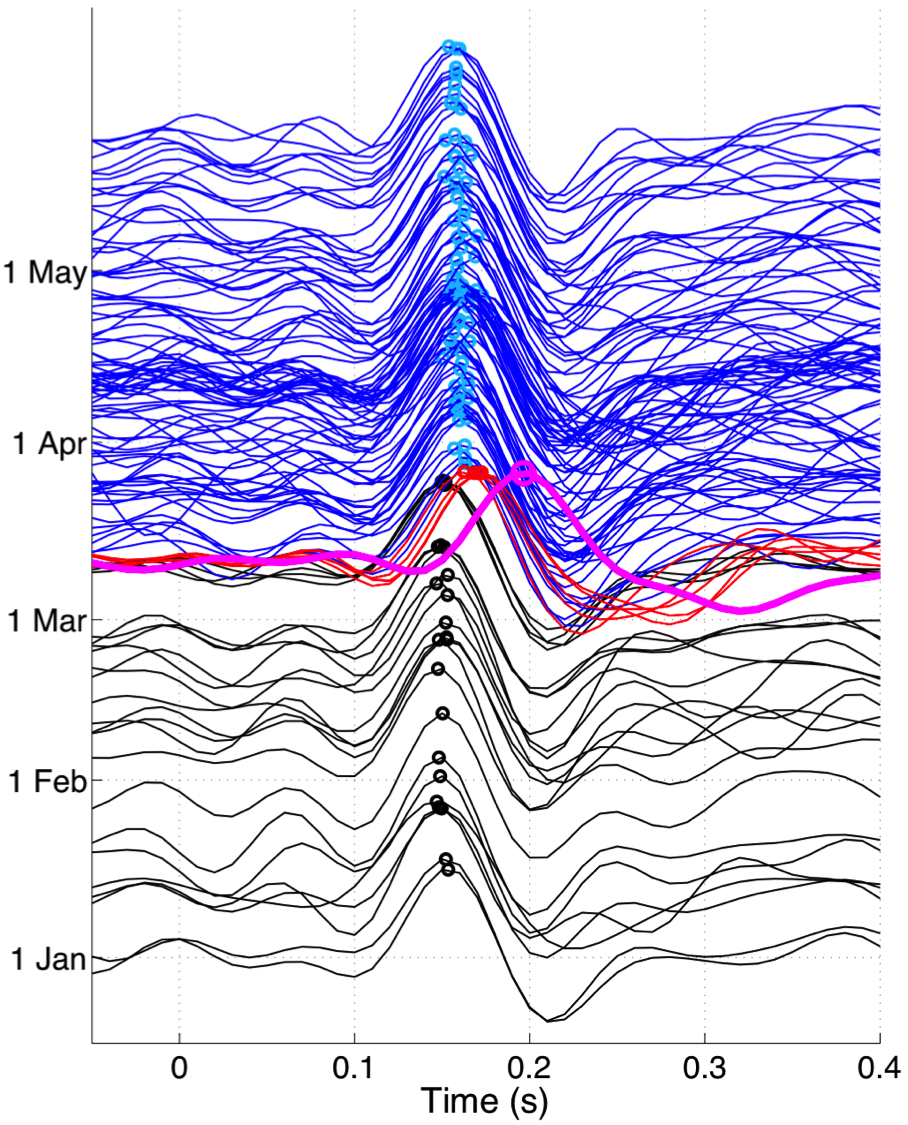
also for volcano monitoring. The volcanic tremors on Arenal (a volcano
in Costa Rica) can be used to monitor the volcano without an active
source, see our recent paper in Geophysical
Research Letters. With Alex Gret I have also analyzed data from
Mount Erebus, the volcano shown on the here that is located in
Antarctica. Using data collected by Rick Aster from New Mexico Tech we
show that the waveforms in the volcano change drastically over a time
of
about two days. This is a very short time-scale for a body as large as
a volcano!
With MSc-student Tamara Gipprich I recently started a
project Dynamic Triggering of Landslides that is is funded by the
National Earthquake Hazards Reduction Program (NEHRP) of the USGS.

Inverse problems play an important role in geophysics because they form the basis for making inferences about the Earth's interior from observations. Linear inverse problems are fairly well understood. Nonlinear inverse problem have no general solution. I analyzed this problem using perturbation theory. In general, model estimation leads to an estimated model that differs from the true model. Describing the relation between the estimated model and the true model is called the appraisal problem. A major hurdle is to develop theoretical and practical tools to deal with the appraisal problem for nonlinear inverse problems. In 2004 I organized a summer school "Mathematical Geophysics and Uncertainty in Earth Models" that was held at the Colorado School of Mines. Researchers and students from all over the world attended the school to learn from each other and to set up collaborations.

Since 1986 I have worked on several aspects of wave
propagation with applications in both global seismology and exploration
seismology. This work includes surface wave scattering theory, ray
perturbation theory and diffraction theory. An example made by Jesper
Spetzler is shown in the figure to the left. A plane wavefront
propagates through a velocity model indicated by grey tones. The curves
show the true travel time (red), the travel time predicted by ray
theory (yellow) and the travel time predicted by our new diffraction
theory (blue). Note that this new theory is a vast improvement over ray
theory!

Surface wave tomography is a prime tool for mapping the shear-velocity structure in the Earth. We have applied this to infer the shear-velocity in shallow sediments, but we also use surface wave tomography to make images of the upper few hundred kilometers of the Earth. The figure shows the surface wave phase velocity for a period around 100 km under North America. This image was created by Stephany Godey in a joint project with Harley Benz at the USGS in Golden, CO. Note the strong correlation between the seismic velocity and tectonic features such as the Gulf of Mexico!
Any opinions, findings, and conclusions or
recommendations expressed in this material are those of the author(s)
and do not necessarily reflect the views of the National Science
Foundation.
Return to the top of Roel Snieder's Research page.