Article content
Critical minerals are ultimately deemed critical for one reason: They’re essential to the fabrication and manufacturing of important products. The process that began with exploration, recovery and refinement ends with a product, whether it’s the phone in your hand or the electrical grid that powers it.
Whether for energy infrastructure, defense technology or the portable devices that are part of daily life, the end use of critical minerals drives the entire value chain. Mines researchers focused on downstream products that rely on critical minerals are pushing the conversation in their respective fields, driving innovations that are shifting how we use critical minerals in magnets and batteries, high-performance steel, nuclear energy and more.
Eve Mozur: Materials discovery for new magnet and battery chemistries
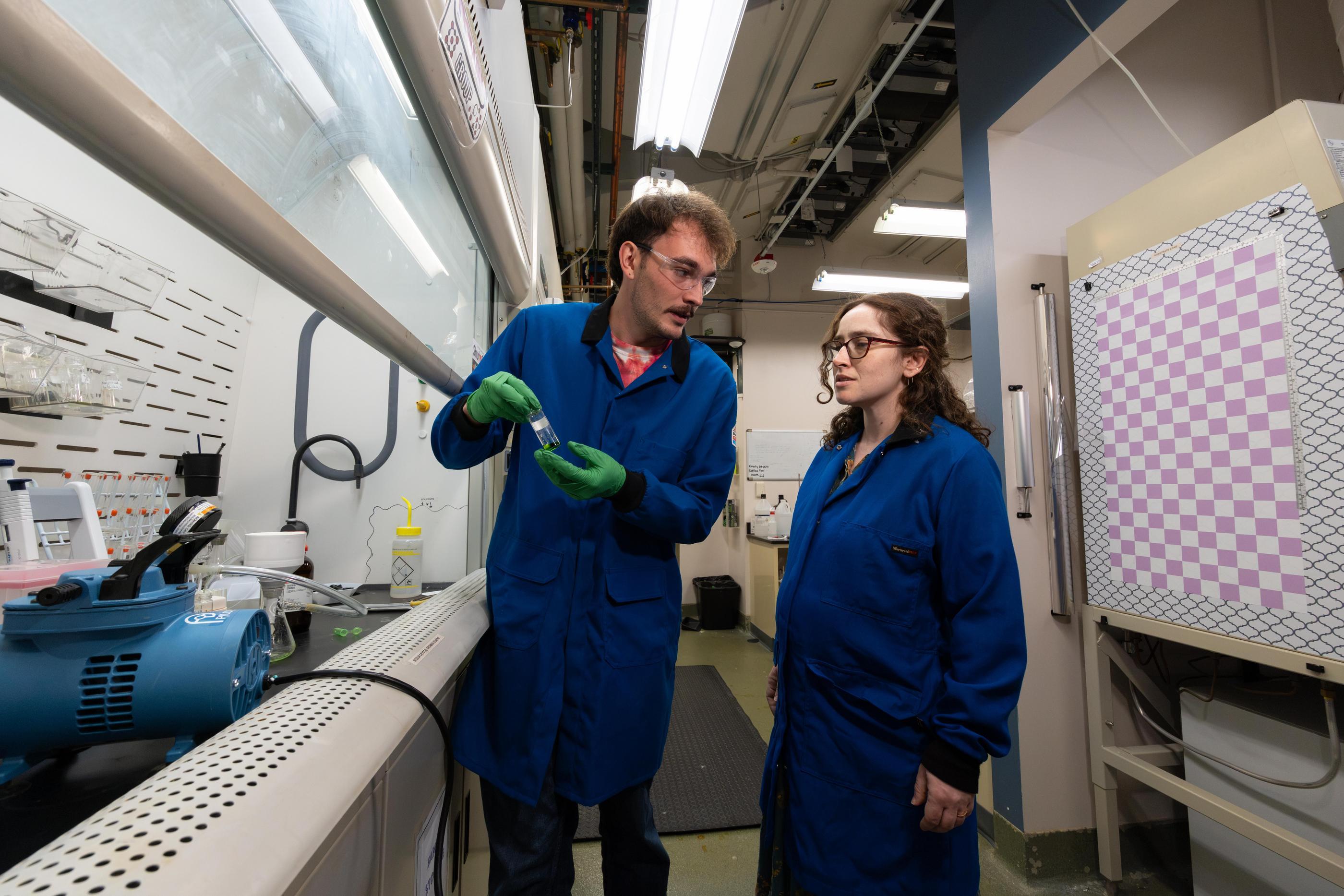 Magnets are everywhere in our lives, from small electronics devices to grid-scale energy infrastructure. But the difficulty of sourcing the rare earth elements used in many magnets is driving a new frontier in materials discovery: Finding new materials that can both outperform their magnetic predecessors and replace rare earths.
Eve Mozur, assistant professor of metallurgical and materials engineering, is searching for ways to reduce rare earths in magnets by substituting manganese, a relatively abundant critical mineral with properties that suggest it could be an untapped resource for new magnet chemistries.
In a new project, Mozur and Vladan Stevanovic, professor of metallurgical and materials engineering, are taking a big-data approach to investigating manganese replacements for the rare earth element neodymium in permanent magnets. The project uses combined computational methods, partially driven by artificial intelligence and machine learning, with experimental classic solid-state chemistry to try to find new battery materials using manganese that could reduce or eliminate the need for neodymium.
“It’s very much materials discovery, looking at patterns that might be hard for humans to detect,” Mozur said. “Once we see them, we can run with them and potentially pick up exciting materials that haven’t been discovered yet, maybe even doubling the performance of neodymium iron boride.”
Neodymium iron boride, an alloy of neodymium, iron and boron, is the strongest permanent magnet available. But while neodymium is fairly abundant in the Earth’s crust – despite the “rare” label – China is the primary producer and processor.
“There's been a big push over the last several decades to try to replace it, but it's such a good magnet and is used in so many industries,” Mozur said. “It's a tall order to try to get it out of technologies that we use.”
“People have looked into manganese materials before, but not with this lens,” Mozur said. “At first pass, they just don't seem as appealing because of what we know about the manganese materials that already exist. But hopefully with the big data approach, we can push those boundaries and find exceptions to what we think of as the general rules. Even if we still have to rely on neodymium, what if we could use half as much?”
In another manganese-based research project, Mozur is also working to better understand multielectron redox reactions. The lithium-ion battery storage systems used on power grids use cobalt oxide as an intercalation material to move lithium ions, deploying electricity and then reversing to recharge. Redox reaction methods using manganese and iron oxides could shift battery storage away from cobalt, a critical mineral with fraught geopolitical implications. At the moment, redox mechanisms don’t offer the same recharging capabilities as lithium-ion batteries. Her work seeks to understand those limitations and whether other materials could solve the problem.
“We’re trying to build a better mouse trap,” Mozur said.
Kip Findley: Boosting high-performance steels with critical minerals
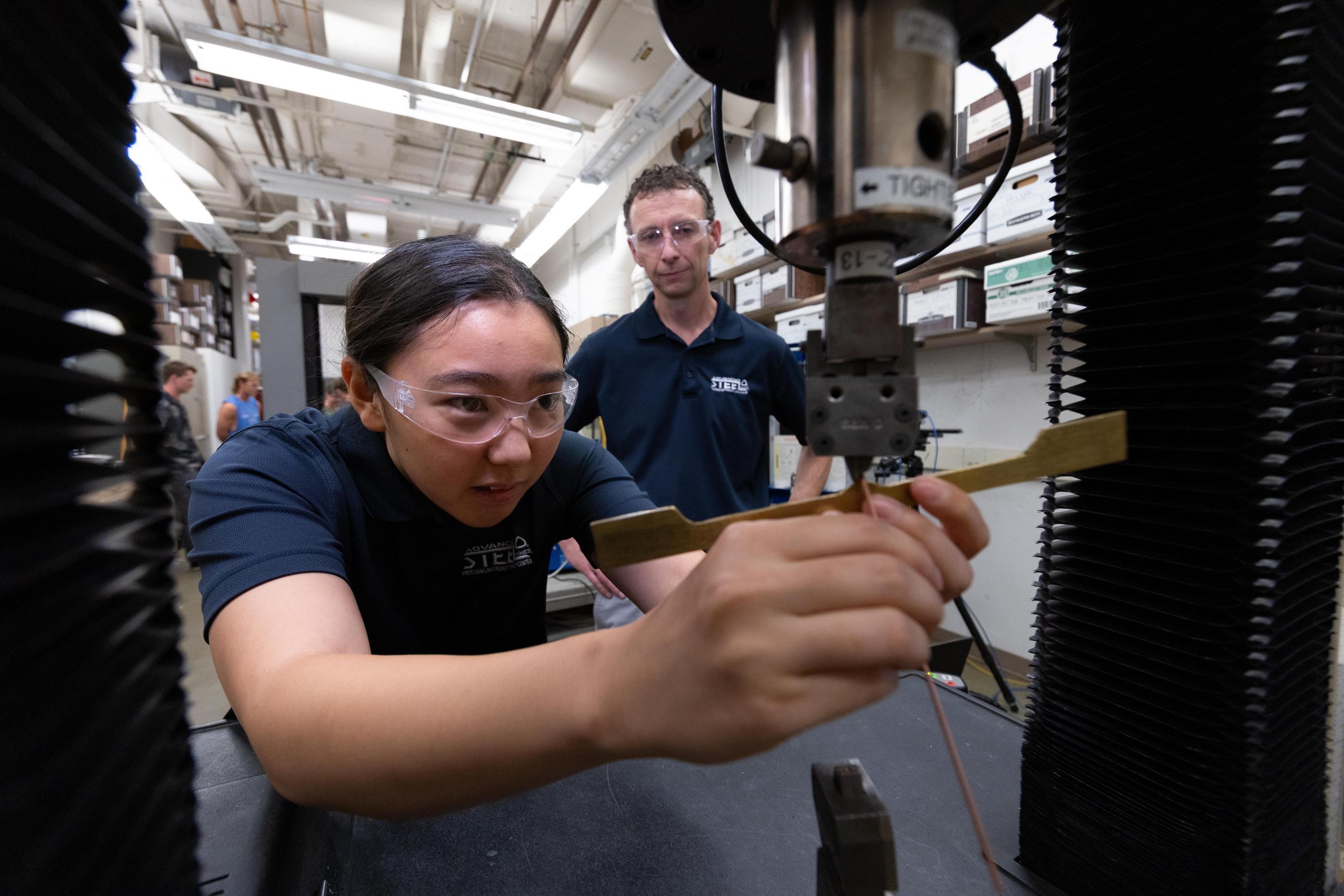 Steel is used around the world more than any other alloy system. But while iron ore is abundant, two less-available critical minerals, niobium and vanadium, are essential for the micro-alloying processes that boost high-performance steels used in applications that call for unparalleled toughness.
“Niobium and vanadium aren’t easily substituted, but we use them strategically in small quantities because they have a big impact on performance,” said Kip Findley, John Henry Moore Professor of Metallurgical and Materials Engineering and director of the Advanced Steel Processing and Products Research Center (ASPPRC), a research center that studies steel production and use.
The steel center is a globally recognized research center that started more than 40 years ago as an Industry/University Cooperative Research Center funded by the National Science Foundation. It’s now self-supported through global industry partnerships and federal funding. Findley, whose research focus is mechanical metallurgy and microstructures in steel, has been the center’s director since January 2025.
The steel center has several projects investigating how niobium and vanadium can control the microstructure of various steel products during heat treatment to achieve higher performance, strength and formability. For gear steels, which are carburized at high temperatures to add carbon to the gear’s surface for fatigue and wear resistance, researchers at the steel center have found that adding niobium, vanadium and molybdenum can improve microstructure refinement at the surface of the steel, making it even more resistant to fatigue.
The center also partners with industry to improve pipeline steels, which are subject to extreme cold and impurities in oil and gas streams that can affect steel’s durability. ASPPRC studies the influence of niobium and vanadium on these steels to understand the atom-by-atom control they exert on steel’s microstructure, then measures performance through tensile and toughness testing.
“There are constant innovations in these processes that can be made,” Findley said.
“Carburizing is a longstanding heat-treatment process, but we’re still making big advances. Similarly, we are pushing technological innovation in thermomechanical processing, in conjunction with microalloying, to achieve higher strength and toughness in plate and pipeline steels.”
Jenifer Shafer: Innovative separation technologies for nuclear fuels recycling
.jpg) Power-hungry data centers have renewed interest in nuclear energy and returned the uranium needed to fuel reactors to the USGS critical minerals list.
Power-hungry data centers have renewed interest in nuclear energy and returned the uranium needed to fuel reactors to the USGS critical minerals list.
Jenifer Shafer, professor of chemistry and Ben L. Fryrear Presidential Chair, began researching the nuclear fuels as a separation chemist long before the AI boom sparked a nuclear renaissance. Her work examines the full nuclear fuel cycle, including uranium recycling technologies.
“We have access to uranium here in the U.S., but if you recycle it, you don’t have to keep getting more uranium,” said Shafer, who recently completed a tour at the U.S. Advanced Research Projects Agency-Energy (ARPA-E), where she served as a program director and associate director for technology for advanced nuclear energy projects. “That can provide energy security.”
Shafer’s research investigates methods to improve recycling of uranium fuel rods, which are only 5 percent spent by a reactor. The remaining 95 percent of the uranium splits during the reaction, but it can be reconstituted — in some cases, on site — and reused.
When used for fuel in nuclear reactors, uranium is processed into ceramic pellets that are stacked in fuel rods. “You can chop up the ceramic, dissolve it in acid, pull the energy-producing elements of the fuel, and put it back in the reactor,” Shafer said.
The uranium recycling techniques currently in use around the world work well for obtaining a pure fuel, but the other chemicals used by the solvent separation systems come into contact with radioactive materials, creating another waste stream. “As a consequence, you have a significant waste management cost with managing your secondary waste,” she said. The current processes for recycling uranium make it about eight times more expensive than using fresh uranium, and utilities with reactors in the U.S. often opt for cost savings.
Shafer’s research group is exploring two different separation technologies. Her work in solvent technology seeks ways to optimize recycling to reduce both costs and waste. She’s also investigating efficiency improvements in an electrochemistry-based recycling method called pyroprocessing. This separation technology uses molten salt as a medium to separate spent nuclear fuel materials.
“There are opportunities for improving the efficiencies of these processes so you’re not generating as much waste or having as big of a facility footprint,” she said. “We could provide a more economic option that’s safer from a nonproliferation standpoint."
To learn more about Mines' leadership in critical minerals across the full value chain, visit criticalminerals.mines.edu.
/filters:format(webp)/prod01/mines/media/minesedu/admin-media/placeholder-images/Guggenheim.png)
About Mines
Colorado School of Mines is a public R1 research university focused on applied science and engineering, producing the talent, knowledge and innovations to serve industry and benefit society – all to create a more prosperous future.

.jpg)