Article content
The constructed world all around us – the buildings, roads, bridges and more – need engineers that understand how to both manage aging infrastructure and oversee new projects that integrate into existing structures.
The Bachelor of Science in Construction Engineering at Colorado School of Mines is helping to meet that need, preparing students to enter an in-demand field and become industry leaders.
Often considered a sub-discipline of civil engineering, Construction Engineering at Mines highlights the importance of engineers who focus specifically on construction and infrastructure systems and the design challenges involved.
"We’re seeing the knowledge and the need for people to specialize in construction engineering because today’s built environment is much more complex than what it was 20 to 30 years ago,” said Paul Goodrum, professor and Kiewit Corporation Endowed Chair in Construction Engineering. “To build a new project that can integrate into the built environment takes a different mindset.”
A good construction engineer can think both about the design of a project and its constructability, Goodrum said. From the start of a project, construction engineers work with designers to consider logistics like cost, materials, the availability of craft labor and schedule. They need to be able to balance multiple priorities and problem solve quickly while also considering the myriad facets of a project.
“Our Construction Engineering program at Mines is developing that next generation of construction engineers who are well geared to work on heavy civil and industrial projects, where we typically see some of the more complex types of construction,” he said.
Industry supported education
Since launching three years ago, the program has been growing with support from industry — namely, the Kiewit Corporation.
Kiewit is one of the largest construction and engineering firms in the U.S., and Mines Board of Trustees chairman Bruce Grewcock ‘76 has spent the majority of his career with the employee-owned company, continuing to play an active role as Kiewit’s executive chairman after serving as CEO from 2005 to 2020.
Together, they made $4.3 million gift to the Construction Engineering program in 2025 establishing the endowed chair that brought Goodrum, a longtime faculty leader in construction engineering and management, to Mines. The Kiewit Chair was envisioned as an educator and connector, bridging classroom learning with real-world applications and engaging companies across the construction ecosystem.
Goodrum came to Mines from Colorado State University, where he led the Department of Construction Management for five years. Previously, he was also a professor at the University of Colorado Boulder and the University of Kentucky and spent several years working as a civil engineer, primarily on heavy construction projects. He holds a PhD in civil engineering from the University of Texas at Austin.
Under Goodrum’s leadership, the program is pursuing accreditation by ABET, which will make it easier for graduates of the program to obtain a Professional Engineer license.
Program coursework provides a solid foundation in civil engineering and a core in construction engineering, including construction methods, cost estimating, planning and scheduling and project control and management, and exposure to structural engineering and geotechnical engineering.
Goodrum envisions the program evolving as industry needs changes, and students being able to build specializations tailored to whichever part of construction engineering they are drawn to working in.
“Eventually, I would like to see pathways for students to become specialized if they want to,” Goodrum says. “Those who want to focus on industrial construction would be on a different career path than students who want to go into commercial construction. But our curriculum will always provide students with pathways that prepare them to be ready to work where industry has the biggest needs. Our students will be ready to work on some of the biggest projects at the best companies in the industry.”
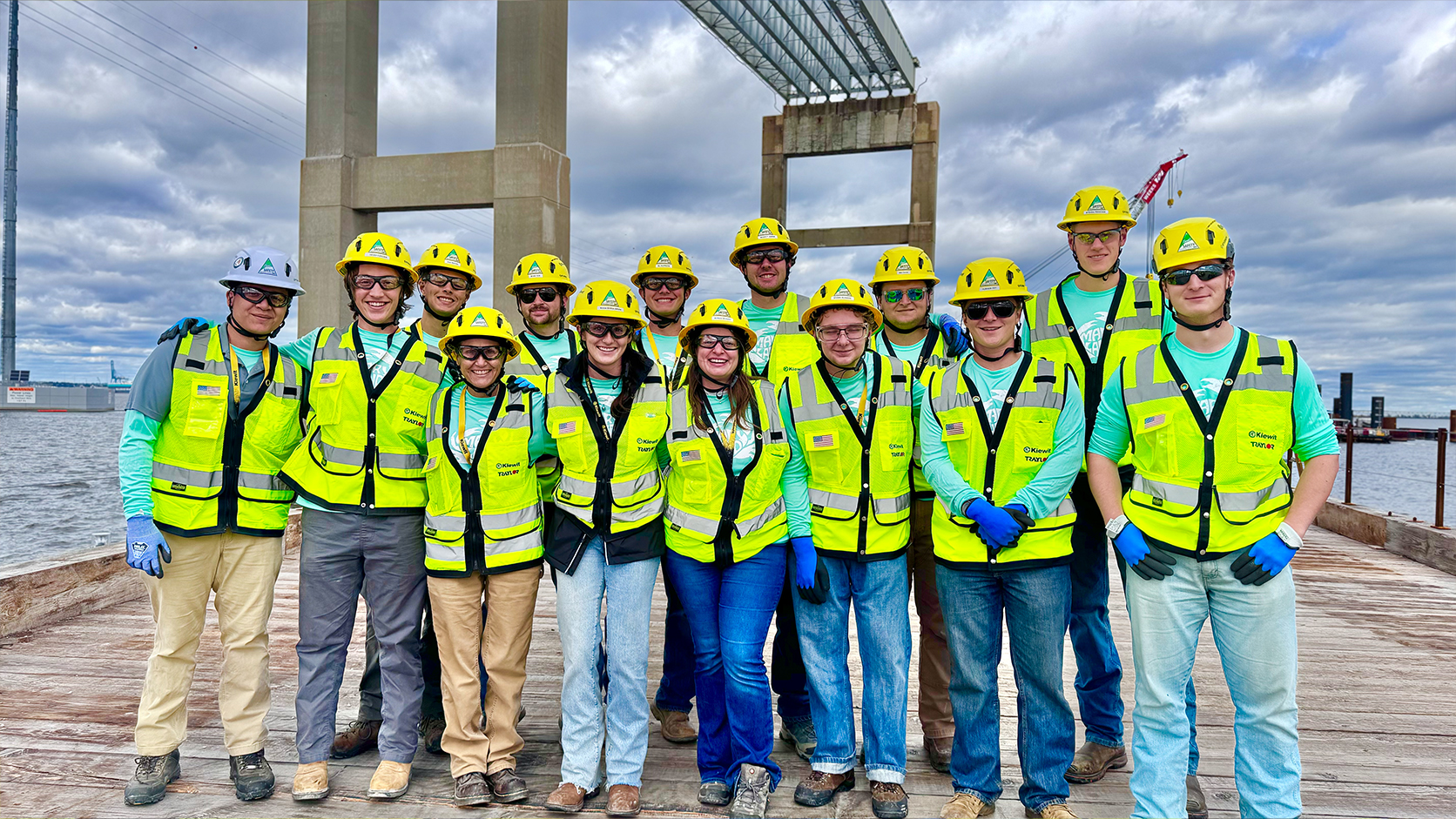 Kiewit Scholars in the Construction Engineering program visit active construction projects. In Fall 2026, the group visited the Francis Scott Key Bridge rebuild project in Baltimore.
Developing industry leaders
Kiewit also invested $2 million into developing the Kiewit Scholars, a three-year scholarship program that provides Construction Engineering students with professional development, site visits and other immersive experiences.
The first cohort of Kiewit Scholars includes Jake Dinklenburg, who is set to graduate in December 2026 with his bachelor’s degree in construction engineering and a master’s degree in civil engineering with a focus on structural engineering.
 Jake Dinklenburg
Raised in Illinois, Dinklenburg came to Mines because of its reputation as a top-flight engineering university. After a tough first year, switching to the then-new Construction Engineering program was what convinced him to stay at Mines.
“Freshman year hit me unexpectedly, but once I got through it, ultimately the reason why I stayed was switching to construction engineering and getting the Kiewit scholarship,” he said. “It was the best decision ever and I’m glad that I stayed.”
Some of the most valuable experiences Dinklenburg had were the opportunities to see what he was learning in class being applied at active construction sites, both on the Mines campus and around the country, visiting heavy construction projects in Phoenix, Baltimore, Fort Worth, Texas, and more with his fellow Kiewit Scholars.
It wasn’t just learning how to design, manage and run the operations of a construction project, either; through what he’s learned in the program, Dinklenburg feels confident talking to people in the industry and working together for a common goal.
“Construction is such a people-focused industry. This program gave me a really good technical foundation, so once you know how to think hard and solve problems and then be able to understand how the people side of a business works, you’re going to be successful,” Dinklenburg said. “You can't just sit at your desk all day and do calculations and design. You need to go out in the field, see how the work's done, and I think that our degree really breeds that kind of drive in their engineers.”
Having a strong partner in Kiewit has been valuable in connecting students with the most up-to-date and latest in construction industry technology, Goodrum said.
“Kiewit is well known for their rigorous project control systems, and they do use a lot of state-of-the-art methods,” he said. “Our students are learning from some of the best systems in the country.”
Now hiring: Construction engineers
After graduation, Dinklenburg already has the next phase of his career set: he’ll be working for BP in Houston as a Wells Engineer Graduate, an entry-level engineering role with progressive growth opportunity. He didn’t expect to be working on projects in the oil and gas industry, but he found that his academics and hands-on learning experiences at Mines were what employers were looking for, even outside the industries he expected to find a job.
“Being able to explain to future employers that I have experience in operations and civil engineering has shown that I have a real breadth of knowledge,” he said.
Dinklenburg said he’s already thinking about growing into an industry leader who comes back to campus to recruit.
“The people that come out of this program are going to be the best in the industry,” he said. “I’m really excited to see how the program grows over the next decade, and I want it to be the best in the country. I personally can’t wait to come back and recruit construction engineers.”

About Mines
Colorado School of Mines is a public R1 research university focused on applied science and engineering, producing the talent, knowledge and innovations to serve industry and benefit society – all to create a more prosperous future.