
Article content
Traditionally, any technology sent into orbit and beyond has had to carry its own propellant to maneuver through space. Need to change position? Take your fuel—typically a gas like xenon, krypton or argon—zap it with electricity to create ions and then blast those ions out to move in the direction you want to go.
But those gases are expensive, and smaller devices, like satellites, can’t carry a large supply.
“The big limitation on satellites today is they have propellant but they can’t maneuver,” said Ashle Jantzen ’25, founder of the startup Leyden Space. “If they do, they cut the life cycle of the satellite in half.”
That means a satellite costing $50 million could lose as much as 10 years of its operational life simply by using its limited propellant to reposition itself.
“Propellant is incredibly limiting, especially when the typical electrical propulsion systems we have are from the 1980s,” Jantzen said. “I think we have come up with a more compelling propulsion that has a lot more potential for faster travel and much better use of resources.”
Through Leyden Space, Jantzen is developing an electromagnetic propulsion system designed to solve that problem by using the atmosphere itself as a source of thrust. Rather than relying entirely on onboard fuel, the system collects ions and particles surround the spacecraft and magnetically accelerates them to generate thrust. The technology could allow satellites to move positions or avoid space debris without carrying and consuming as much propellant, something that is becoming increasingly important as Earth’s orbit grows more crowded with active and inactive spacecraft.
Jantzen also sees potential applications beyond satellite maneuvering. The company is developing hybrid propulsion systems that could make longer space missions faster and more feasible. Below an altitude of 500 kilometers, the system could operate without onboard propellant by using particles in the surrounding atmosphere. At higher altitudes where fewer particles are available, the system would use a small amount of onboard fuel with the same electromagnetic acceleration technology.
“Our acceleration system is really efficient and is what allows for the really high performance,” said Jantzen.
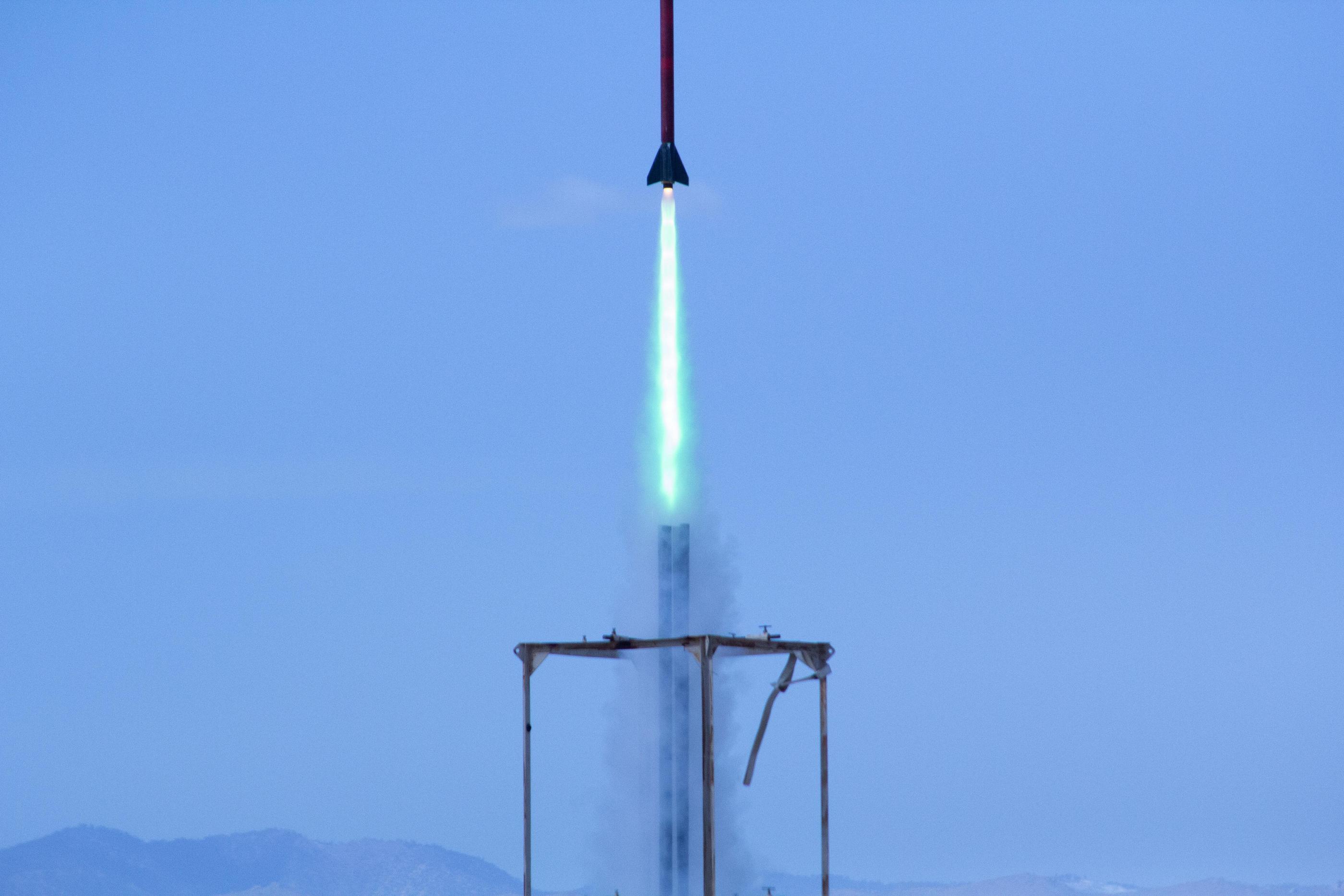
Jantzen first came up with this idea as a Mines undergraduate while participating in the Space Shot project with the Mines Rocket Club, which she considers her first startup. The team built and launched a two-stage rocket that reached 43,476 feet above the Mojave Desert in California—one of the highest collegiate staged flights in recorded history.
“The process was exhausting and I hardly every slept, but I loved every second of it,” she said.
Throughout this process, starting a space company was always in the back of her mind, but Jantzen thought it would only happen after she finished graduate school and had some industry experience.
“My original plan was to spend a few years in industry to gain some experience and, most importantly, confidence,” she said.
She had enrolled in Mines’ space resources graduate program, but another opportunity soon came way.
The Rocket Club was invited to present their project to alumni, donors and the university’s Board of Governors. At lunch, she had a “little bit of luck,” she said, and was seated at the same table as Zack Bennett ’99, director of the Mines Venture Program and the Beck Venture Center. When someone asked Jantzen what she planned to do after school, she said that she wanted to launch her own aerospace company to focus on these kinds of propulsion systems. That’s when Bennett pitched her to see if they could help.
She postponed grad school to found Leyden Space with their support. The Beck Venture Center “provided the mentorship, resources and entrepreneurial runway to transition a deep-tech concept into a commercial venture,” she said. Not only did the Center help the company get off the ground in terms of setting up a business, but they also connected them with venture capital investors and other space companies.
Even though it was all a risk, so far, Jantzen has seen it work out. She knew if her goal was to build something never built before, she “likely wouldn't find the blueprints in something or a company, that already exists,” she said. “The amount of learning, growth and perseverance I would need to pull this off could only ever come from building this idea and not from waiting until it felt right. There was also a part of me that felt like I had to build this and that I couldn't just sit on it.”
/filters:format(webp)/prod01/mines/media/minesedu/admin-media/placeholder-images/Guggenheim.png)
About Mines
Colorado School of Mines is a public R1 research university focused on applied science and engineering, producing the talent, knowledge and innovations to serve industry and benefit society – all to create a more prosperous future.