Article content
Artificial intelligence’s influence in everyday life continues to accelerate and shows no signs of stopping.
Generative AI, fueled by large language models like Claude, ChatGPT and Google Gemini, is changing the way people communicate. These kinds of AI tools produce ideas in response to prompts, based on patterns recognized from large datasets.
In certain industries, adoption rates are high – according to a Gallup survey, 75 percent of workers in tech responded that they use AI in their jobs.
At Colorado School of Mines, computer science faculty are preparing students for AI-integrated workplaces by ensuring they not only understand programming fundamentals but also have mastered the concepts behind them and are able to use AI as an efficiency tool, not a replacement for human skill.
“It’s very important for computer scientists to learn how to use AI tools more effectively, because most likely, you are going to be asked to use these tools but also to use them in a way that’s responsible,” said Iris Bahar, professor and head of the Computer Science Department at Mines.
Full competency in AI tools will be an expected skill for careers in the tech industry in five to 10 years – if not sooner, said Rob Thompson, teaching associate professor of computer science.
“The notion of technical literacy is going to involve a level of competency and knowledge of the workings of AI, and large language models more specifically,” Thompson said.
AI literacy across all majors
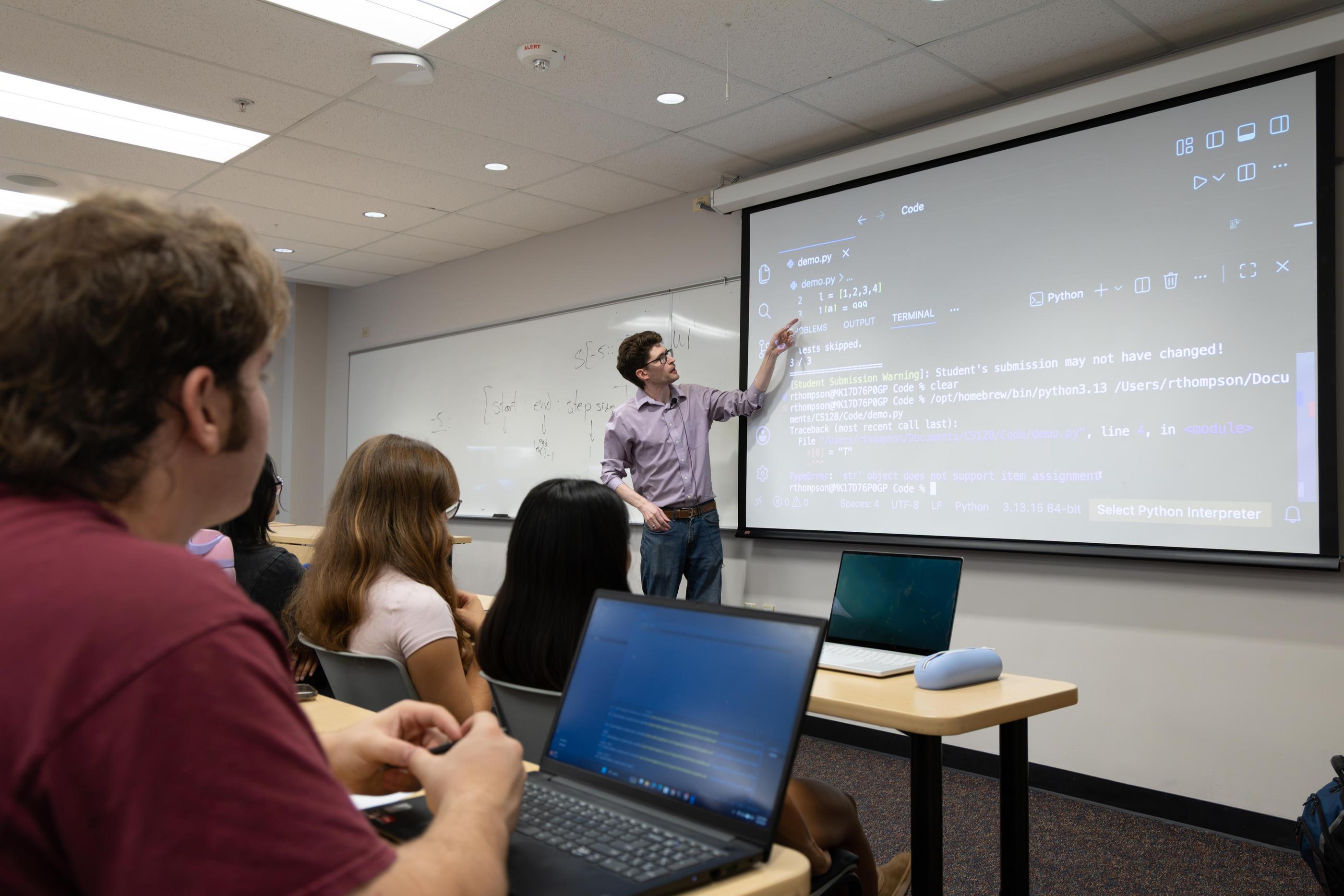
That understanding of AI is part of the curriculum at Mines not just for computer science majors, but for all undergraduates. In CSCI128, Computer Science for STEM, a programming course taken by all Mines undergraduates, students are introduced to topics like data science, code development and -- especially relevant when it comes to AI – software ethics.
The three computer science faculty members who teach CSCI128 – Thompson, Teaching Associate Professor Kathleen Kelly and Professor of Practice Christine Liebe – have developed a number of AI-related assignments for the hundreds of students in the course. The goal is to make students literate in AI while still maintaining academic integrity.
“We’re trying to intentionally talk more about AI and also provide real-world use cases, so the code they’re writing isn’t just busy work,” Kelly said. “We’re showing them how some of the models will work ‘under the hood,’ so to speak.”
By the end of the course, students will have “a really solid sense of what Google Gemini is doing behind the screen when you ask it a question, and it gives you 10 paragraphs in two seconds,” Liebe said.
And while programming classes used to focus on teaching students to write code, AI has meant a shift toward reading, testing and better understanding code instead of simply writing lines of it. One of the ways CSCI128 is doing this is by taking what might be considered a low-tech approach.
“Two years ago, 100-level classes were project based, with weekly programming assignments. Now, to protect student thinking, the courses are mostly exam-based, with handwritten quizzes every two weeks and a large final exam,” Liebe said. “These tools are advancing rapidly, so we want to foster enduring human skills and knowledge and problem decomposition. We want to deepen students’ understanding of the advantages and disadvantages of AI.”
The ease at which generative AI can regurgitate code means a course like CSCI128 can be vulnerable to students using it for shortcuts, so faculty are creating assignments that deliberately use AI, with transparency. One idea, Kelly said, is a project where students will work on a team to come up with a concept and then use AI to iterate on it. The team would then review and pare down some of the AI suggestions, and the AI transcript would be part of the project materials that are turned in.
The Trefny Innovative Instruction Center at Mines has been a valuable resource in developing a curriculum that thoughtfully incorporates generative AI, Kelly said. The center is leading an AI@Mines initiative, so faculty can intentionally design their course in a way that is both focused on learning and supportive of students.
Diving deeper into AI
For more advanced computer science classes at the undergraduate level, like CSCI306: Software Engineering, students are expected to first write code by hand, ask generative AI to produce something similar, and then compare the results.
Students who want to create large language models or work in generative AI will find several upper-level courses in the CS department that provide this opportunity. They also have the option to specialize by following one of two relevant tracks within the major: data science or robotics and intelligent systems. The data science track incorporates courses from the Department of Applied Mathematics and Statistics, while the robotics and intelligent systems track requires courses from both the Mechanical and Electrical Engineering Departments. Computer Science students following these tracks are required to take AI and machine learning courses. Other AI-related courses offered as electives include Deep Learning, Full Stack LLMs, and Computer Vision.
For all undergraduate computer science students, AI will continue to show up in their classes as they progress through the program. Bahar said there are plans to add more AI-centric classes in the next year, including a class that teaches students how to use agentic AI – a program that can take action with a certain degree of autonomy – to build software systems.
“It’s about building large software systems with the use of these tools and learning how to reason with them, how to iterate and manipulate the code and integrate them together to build the system that you’re trying to make,” Bahar said. “That requires a fair amount of software reasoning and sophistication.”
Future proofed careers
The future of AI and how it will continue to change the computer science field remains to be seen. So how do you prepare students for jobs that could drastically change or don’t yet exist? And with the growing impact of AI on the job market, is a computer science degree even worth it?
Absolutely, Bahar said, and specifically a Mines degree, because of how courses are being continuously evaluated and updated as technology evolves.
“There will still be a need for computer scientists because someone needs to know how to reason with these software systems and how to evaluate them, especially from an ethical point of view. They also have to be able to build the AI systems of the future. Computer scientists will have plenty of work to do,” she said.
Bahar said Mines is also considering adding an AI-focused graduate degree that builds on the strengths of Mines’ approach to computer science education.
“We want to teach the practical skills that are very useful, obviously, but we are interested in setting a foundation that will stand the test of time and teach concepts that will live past the next year, or the next five years, or hopefully even the next 20,” Thompson said. “I would much rather teach something that lets students learn and critically analyze these tools versus just telling them the basics so they can check a box on their resume and move on.”
Along with giving students a solid foundation in computer science theory, Kelly said Mines emphasizes the skills that will help graduates stand out in a crowded job market.
“Designing systems is going to be a huge part of these jobs,” she said. “Writing the code is the easier part if you have a good design and can solve problems first on paper or a whiteboard. Good design skills will give you a leg up. We can teach them how to do that, along with social skills and being a team player. These things are important, and we push a lot of those skills throughout the program.”
No matter how technology continues to change, and jobs evolve, Bahar said Mines won’t stop imparting the ethical responsibility involved in using AI tools.
“Part of it is not being afraid to use these tools but also understanding as you interact with them what the limitations are,” she said. “It's important for students to not forget to stop and do critical thinking along the way when using these tools, and analyze what the AI is generating. Use these skills while keeping a skeptical eye out.”
/filters:format(webp)/prod01/mines/media/minesedu/admin-media/placeholder-images/Guggenheim.png)
About Mines
Colorado School of Mines is a public R1 research university focused on applied science and engineering, producing the talent, knowledge and innovations to serve industry and benefit society – all to create a more prosperous future.